Collections and Dunning
Collections and Dunning
"Dunning" is the process of chasing overdue invoices — sending escalating reminders as an invoice gets later. Rather than one blunt reminder, Credit Control follows a defined ladder of steps, and it always respects two things that should stop a chase: an open dispute, and a promise to pay.
The Standard Dunning ladder
| Step | When | Action | Pauses on a promise to pay? |
|---|---|---|---|
| 1 | 7 days overdue | Email reminder | Yes |
| 2 | 15 days overdue | SMS | Yes |
| 3 | 30 days overdue | Phone call | Yes |
| 4 | 60 days overdue | Legal escalation | No |
The pattern is deliberate: relationship-aware early (a customer who commits to paying isn't chased), but firm past the threshold — once an invoice is 60 days overdue, a promise no longer holds off legal escalation.
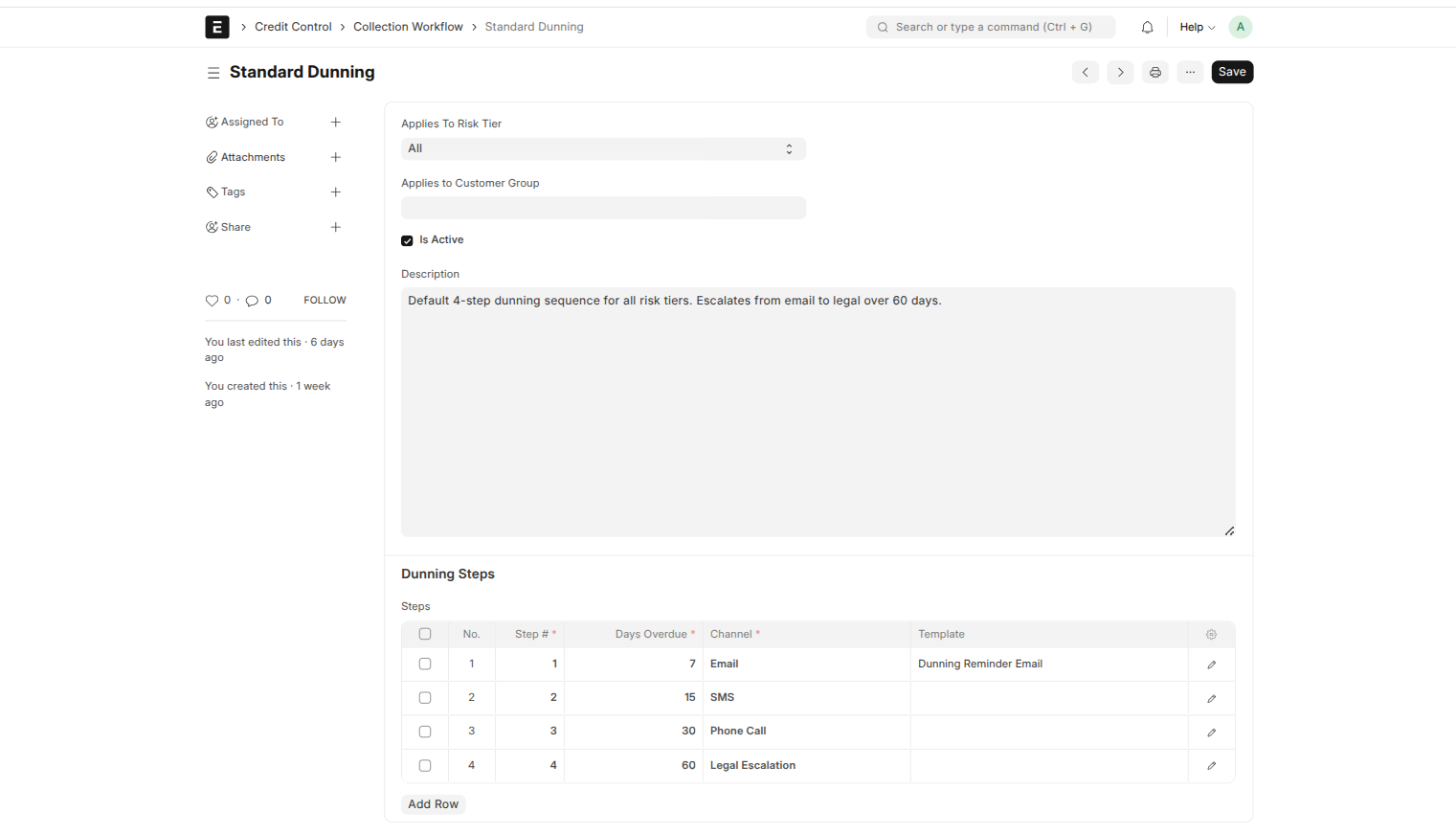
The pattern is deliberate: relationship-aware early (a customer who commits to paying isn't chased), but firm past the threshold — once an invoice is 60 days overdue, a promise no longer holds off legal escalation.
The two hard rules
These are checked at the moment a reminder would be sent, so they always hold:
- Disputed invoices are never chased. If an invoice has an open dispute, the step is skipped and the reason recorded. Nobody is chased for money they're legitimately contesting.
- An active promise to pay pauses the chase. Steps 1–3 are skipped while a promise stands. Legal escalation is the exception.
How it runs
What's still being set up
The ladder and the skip/pause rules are built and working. Actual delivery of emails, SMS, and WhatsApp depends on production communication channels (an email server, an SMS provider) being connected for your deployment — the scheduling and rules run today; live message delivery is a production setup step.